











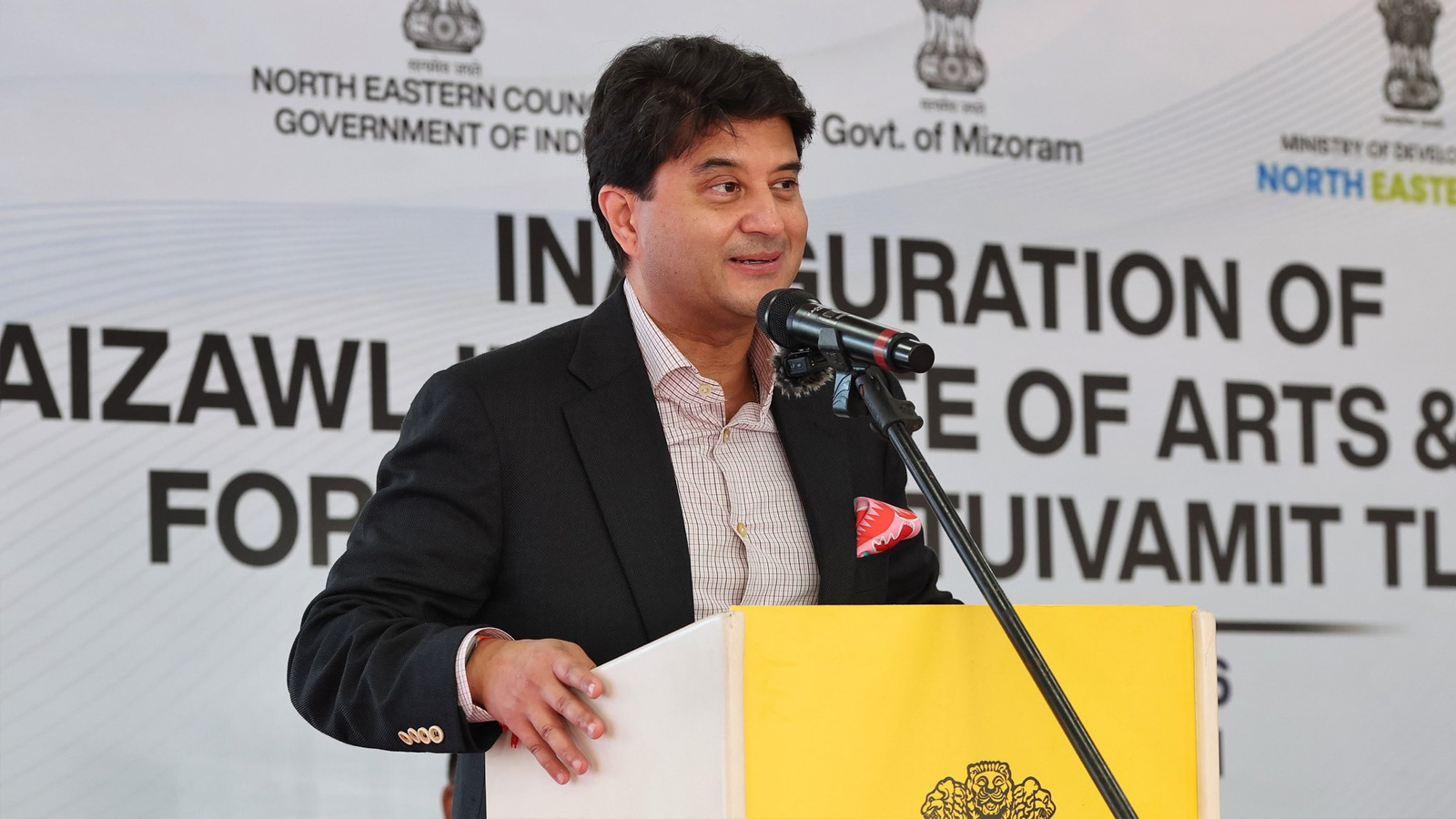
Union Minister for Communications and Development of North Eastern Region Jyotiraditya M. Scindia on Monday inaugurated five projects worth approximately ₹102 crore and laid foundation stones for five more worth ₹228.54 crore in Mizoram, covering connectivity, power, water supply, healthcare, education, sports and culture.
Speaking at Tuivamit in the presence of Chief Minister Pu Lalduhoma, Scindia said the initiatives would turn improved connectivity into economic opportunities and enhance the quality of life across the state.
“Geography may shape the landscape. It must never shape the limits of the people,” he said, emphasising opportunities for farmers, entrepreneurs, young people and local communities.
The projects inaugurated included the ₹17.24-crore Daido–Vangkawt Road in Champhai. The 3.33-km road, developed under NESIDS-Roads, will improve connectivity in the Mizo Ginger pilot region and help transport agricultural produce to markets.
Scindia also inaugurated the ₹54.95-crore, 132-kV Bairabi–West Phaileng transmission line via Mamit. Spanning 74 circuit kilometres, it will strengthen the state’s electricity transmission network.
Other completed projects were the ₹20.50-crore augmentation of the North Vanlaiphai Water Supply Scheme, a ₹2.64-crore AYUSH Development Centre and the ₹6.90-crore Aizawl Institute of Arts and Music for the North Eastern Region at Tuivamit Tlang.
Developed under North Eastern Council schemes, the arts institute aims to nurture talent, preserve cultural traditions and create professional opportunities. Scindia praised the musicians who performed at the programme, particularly the drummers, for showcasing Mizoram’s artistic skills and cultural spirit.
Among the projects for which foundation stones were laid was the ₹100.24-crore Pukzing–Silsuri Road in Mamit. The 21-km project will improve all-weather connectivity. Scindia noted that Silsuri had been identified for a new bank branch, but inadequate road access remained a constraint.
The ₹57.01-crore Tualpui–Champhai Road will cover 21 km across Khawzawl and Champhai districts, improving access to markets and essential services.
The ₹26.49-crore Oil Palm Link Road will extend 32.70 km across Kolasib, Mamit, Lunglei and Lawngtlai. It is expected to benefit nearly 60,000 people in 19 villages by improving agricultural transportation and access to services.
The minister also laid foundation stones for a ₹10-crore, 40-bed hostel at the ANM School in Zemabawk, Aizawl, under NESIDS-OTRI, and a ₹34.80-crore sports infrastructure initiative to expand facilities for young athletes.
Scindia described the investments as supporting both “Routes and Roots”—connectivity linking people and markets, alongside institutions nurturing health, education, culture and talent.
“Routes take Mizoram to the world. Roots keep Mizoram Mizo,” he said.
The minister said the Ministry of DoNER had been allocated ₹6,812.30 crore for the Northeast in FY 2026–27. In Mizoram, 375 projects worth ₹4,617.70 crore had been taken up, of which 295, involving ₹2,692.31 crore, had been completed.
He credited coordination between the Centre and the state for completing nearly four out of every five projects.
Highlighting improved transport links, Scindia described the 51.38-km Bairabi–Sairang railway line as a historic milestone. More than 15 lakh passengers had travelled on over 1,100 train trips, connecting Aizawl with Guwahati, Kolkata and Delhi, he said. The Sairang–Silchar service had further strengthened links with the Barak Valley.
He also recalled the arrival of the first Food Corporation of India foodgrain rake at Sairang in March 2026, carrying approximately 26,000 quintals of rice from Punjab in 42 wagons.
Such direct movement of foodgrains demonstrated how connectivity was bringing distant parts of the country closer, he said.
Mizoram recorded 4,94,362 domestic tourist visits and 7,389 foreign tourist visits in the first six months of 2026, taking the total above five lakh, Scindia noted.
On agriculture, he highlighted the ₹189.79-crore Mizoram Ginger Mission, which aims to connect nearly 20,000 farming households with an integrated value chain covering cultivation, processing, branding, transport and access to domestic and international markets.
“Mizo ginger is Mizoram’s USP; our mission is to make sure the value stays where the ginger grows,” he said, stressing that farmers should receive a greater share of the value generated.
Scindia said the Northeast was emerging as an engine of India’s growth as the national economy expanded at around 7–7.5%. Describing the trip as his 35th visit to the region, he said each visit renewed his commitment to the eight “Ashtalakshmi” states.
He also recalled the longstanding association between Lalduhoma and his late father, while emphasising that development must protect Mizoram’s ecological wealth and cultural identity.
Invoking Hnatlang, the Mizo tradition of voluntary collective work for community welfare, Scindia said development required a shared effort by the Centre, the state government and the people.
Projects should ultimately be judged by their impact on lives—better market access for farmers, improved healthcare and greater opportunities for musicians and athletes—rather than expenditure alone, he said.
His October 12–13 visit also includes interactions with students, civil society representatives and banking-sector stakeholders, focusing on youth empowerment and economic inclusion.







