Massive stars can trigger the formation of new stars in nearby molecular clouds, according to a study conducted by researchers at the Aryabhatta Research Institute of Observational Sciences (ARIES).
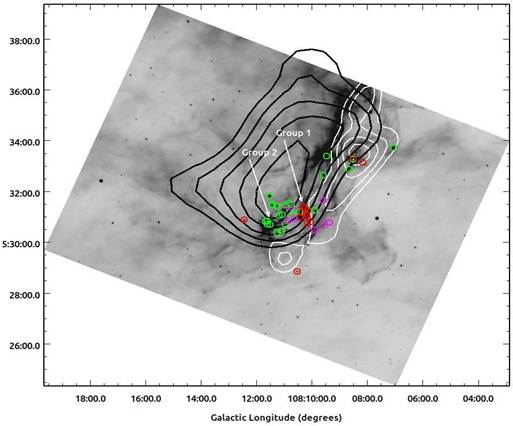
The study focused on a region known as Bright Rimmed Cloud 44 (BRC 44), located nearly 900 parsecs away in the Cepheus OB2 star-forming complex. Researchers found that ultraviolet (UV) radiation emitted by massive stars compresses surrounding gas clouds, creating conditions favourable for the birth of new stars.
Stars are formed within molecular clouds — large accumulations of gas and dust in space. While most stars are comparable in size to the Sun, some are more than eight times its mass. Though rare, such massive stars strongly influence their cosmic environment through intense radiation and stellar winds.
According to the researchers, UV radiation from a nearby massive star ionises the outer surface of BRC 44, heating and compressing the gas within the cloud. The resulting shock waves move deeper into the cloud, increasing gas density and triggering star formation.
The study was led by Mr. Rishi C., a doctoral scholar, along with Dr. Neelam Panwar and collaborators from India, the United Kingdom, China and Thailand.
Using observations from the 3.6-metre Devasthal Optical Telescope (DOT) and the Devasthal Fast Optical Telescope (DFOT) in India, along with archival data from the Spitzer Space Telescope and radio observations from China’s Purple Mountain Observatory, the team adopted a multi-wavelength approach to study the cloud and its stellar population.
The researchers identified 22 new young stellar objects within BRC 44, including several brown dwarfs — celestial objects too small to sustain hydrogen fusion in their cores like ordinary stars.
The study also identified two distinct groups of young stars. One group appears to have formed due to the interaction between the molecular cloud and radiation from the nearby massive star, while the other likely formed around the same period as the massive star itself.
The findings, published in The Astrophysical Journal, suggest that massive stars do not merely disrupt their surroundings but can also contribute to the formation of a new generation of stars.