Scientists have discovered a new quantum phenomenon showing that particles prepared in opposite quantum states can sometimes provide more information than particles prepared in identical states, opening new possibilities for quantum computing, cryptography and measurement technologies.
The findings, published in the journal Physical Review Letters, could help improve the characterisation of unknown quantum devices and strengthen future quantum cryptography protocols.
The study focuses on qubits — the fundamental units of quantum information — and how different properties of their spin can be measured simultaneously.
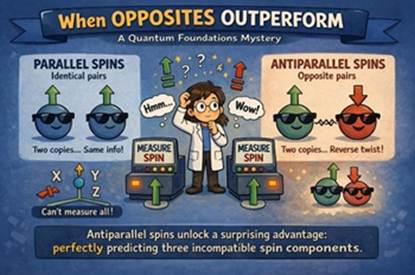
Researchers examined pairs of qubits prepared in two different configurations: one in which both spins point in the same direction, known as parallel states, and another in which the spins point in opposite directions, referred to as antiparallel states.
Contrary to conventional expectations, the researchers found that antiparallel states offer a major advantage in certain quantum measurements.
According to the study, antiparallel spin pairs make it possible to simultaneously predict three mutually incompatible spin components with exactness — something that cannot be achieved using parallel spin pairs.
The research was carried out by scientists from S. N. Bose National Centre for Basic Sciences, Balagarh Bijoy Krishna Mahavidyalaya and Indian Statistical Institute.
The findings challenge conventional assumptions in quantum mechanics, where identical copies of a quantum state are generally considered more useful for extracting information.
The study builds upon fundamental principles of quantum theory, including Bohr’s complementarity principle and the Heisenberg uncertainty principle, which state that certain properties of quantum systems cannot be measured simultaneously with complete precision.
Researchers said the work also has links to the well-known “Mean King’s problem” in quantum mechanics proposed by physicist Yakir Aharonov and collaborators.
Beyond its theoretical significance, the discovery could have practical applications in developing reliable quantum technologies. Scientists said the enhanced measurement compatibility offered by antiparallel configurations may improve the efficiency of quantum device testing and help optimise quantum communication systems.
The researchers also noted that the study highlights an important feature of quantum physics — that introducing contrast or asymmetry into a system can sometimes unlock capabilities unavailable in perfectly symmetric systems.