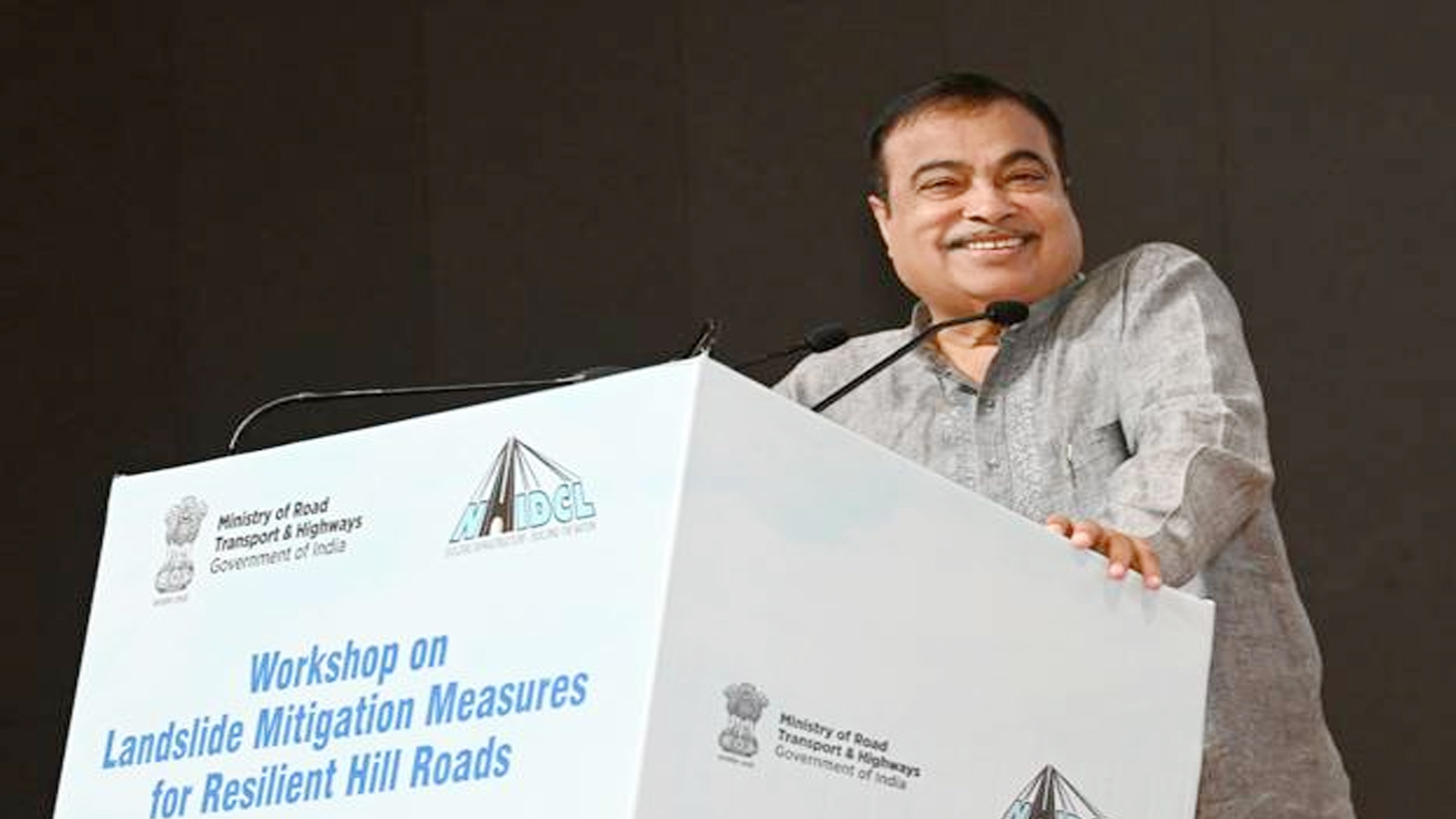
Union Road Transport and Highways Minister Nitin Gadkari on Thursday stressed the urgent need for climate-resilient road infrastructure in the Himalayan region, highlighting the growing challenges posed by landslides, extreme weather, and fragile terrain.
Addressing a workshop on “Landslide Mitigation Measures for Resilient Hill Roads” at Bharat Mandapam, Gadkari said developing safe and durable road networks in hilly areas remains complex due to slope instability, cloudbursts, earthquakes, and other natural hazards.
The minister said the government is adopting global best practices and advanced technologies to tackle these challenges. He outlined several key initiatives, including collaborations with THDC India Limited for landslide treatment in Uttarakhand and Arunachal Pradesh, the Defence Geo-informatics Research Establishment for geo-hazard mitigation, and the Geological Survey of India for geological studies and data sharing.
Gadkari also highlighted cooperation with the National Institute of Rock Mechanics to improve geotechnical assessments, tunnel safety audits, and monitoring systems for infrastructure projects in mountainous regions.
In a significant policy shift, the minister announced that slope stabilisation will now be prioritised before road construction in hilly terrain to enhance long-term safety and durability.
He further noted that the government is supporting the Indian Institute of Technology Roorkee in developing guidelines for managing hillslope instability using real-time monitoring systems. Additionally, an advanced InSAR-based landslide monitoring and early warning system is being deployed along a 100-km stretch of the Char Dham route in Uttarakhand.
The minister said that modern technologies such as LiDAR and UAV-based surveys are being increasingly used for detailed topographical mapping and integrating landslide risk assessments into project planning.
Reaffirming the government’s commitment, Gadkari said the focus remains on building safe, sustainable, and resilient highway infrastructure across India’s hilly regions, particularly in the ecologically sensitive Himalayas.