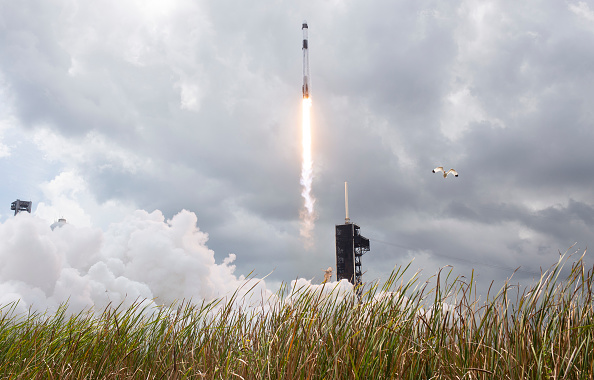
An international crew of four astronauts launched toward the International Space Station from Florida on Friday aboard a SpaceX rocket, embarking on a routine NASA mission that could be the first of many to last a couple months longer than usual.
The four-person crew – two NASA astronauts, a Russian cosmonaut and Japanese astronaut – boarded SpaceX’s Dragon capsule sitting atop its Falcon 9 rocket at NASA’s Kennedy Space Center and beat gloomy weather to blast off at 11:43 a.m. ET (1543 GMT). After a roughly 16 hour flight, they will arrive at the ISS at around 3 a.m. (0700 GMT) on Saturday.
While normal crew rotation missions last roughly six months, the Crew-11 crew may be the first to settle into a new routine time of eight months, intended to better align U.S. mission schedules with Russia’s missions, NASA said.
Over the next few months, NASA officials will monitor the health of SpaceX’s Dragon capsule, which remains docked to the ISS, before committing the mission to a full eight months.
Thursday’s mission, called Crew-11, includes NASA astronauts Zena Cardman and Michael Fincke, Russian cosmonaut Oleg Platonov, and Japanese astronaut Kimiya Yui.
A previous attempt to launch on Thursday was scratched at the last minute because of bad weather.
A delegation of senior Russian space officials, including the head of Russia’s space agency, Dmitry Bakanov, was in Florida for the launch attempt on Thursday, but it was unclear whether they stayed in town for Friday’s launch.
Their visit on Thursday included the first face-to-face meeting between the heads of NASA and Roscosmos, Russia’s space agency, since 2018. Roscosmos said Bakanov and acting NASA administrator Sean Duffy discussed continued ISS operations and cooperation on the moon.
The space cooperation is a bright spot in otherwise largely frosty U.S.-Russia relations since Moscow’s full-scale invasion of Ukraine in 2022.
However, apart from ISS cooperation, Russia’s invasion isolated Moscow’s space program from the West and foiled plans to cooperate on NASA’s Artemis moon program. Russia opted to partner on China’s moon program, which rivals Artemis.
No new commitments on any space programs were made during the brief meeting between Bakanov and Duffy, a person familiar with the discussion said.
(Reuters)