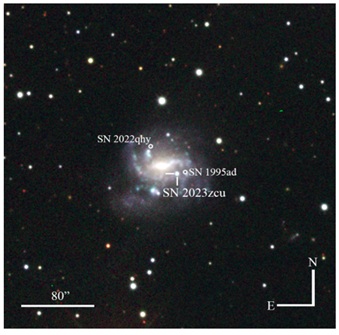
Observations of a supernova discovered in a galaxy about 90.7 million light-years from Earth could help astronomers improve measurements of distances in the nearby universe, according to a study led by Indian researchers.
The supernova, designated SN 2023zcu, was detected on Dec. 8, 2023, less than a day after the explosion occurred at the edge of the spiral galaxy NGC 2139. The study, published in The Astrophysical Journal was conducted by Monalisa Dubey, Kuntal Misra and Naveen Dukiya of the Aryabhatta Research Institute of Observational Sciences (ARIES), along with international collaborators.
SN 2023zcu belongs to the Type IIP class of core-collapse supernovae, the most common type of stellar explosion produced when a massive red supergiant star, typically between eight and 17 times the mass of the Sun, exhausts its nuclear fuel and undergoes gravitational collapse.
Using extensive photometric and spectroscopic observations from ground- and space-based telescopes, the researchers tracked the supernova through its rise, plateau and nebular phases and estimated its distance at about 27 megaparsecs.
The team used the Expanding Photospheric Method (EPM), which determines distance by comparing the physical size of the supernova’s expanding surface with its apparent brightness. Researchers said the method is particularly effective for Type IIP supernovae because their thick hydrogen envelopes produce a well-defined expanding photosphere, while their characteristic plateau phase provides stable conditions for distance measurements.
Early spectra showed very little interaction between the supernova ejecta and surrounding gas, suggesting the progenitor star lost only a small amount of mass before the explosion.
During the plateau phase, the spectra displayed prominent hydrogen features, including a strong H-alpha P-Cygni profile, along with signatures of iron, sodium and calcium. As the supernova entered the nebular phase and the expanding material became transparent, emission lines from oxygen, iron, calcium and magnesium became visible, including so-called forbidden lines that appear in low-density gas.
By modelling the supernova’s bolometric luminosity, or total energy emitted across all wavelengths from ultraviolet to infrared, the researchers estimated that the progenitor star had a mass about 12 times that of the Sun. The explosion energy was estimated at about 2 × 10⁵¹ ergs, consistent with typical explosions of red supergiant stars.
The researchers said frequent observations and continuous monitoring of SN 2023zcu have provided insights into the evolution of Type IIP supernovae and could strengthen their use as tools for measuring distances across the local universe.